- Teacher: Kenny-lynn Baccay
- Teacher: Bettina Evio
- Teacher: Jenniffer Paguio
- Teacher: Arnold Peralta

This is a curricular activity aimed to evaluate the alignment of the intended and implemented courses as the College of Nursing shifted to remote learning. This emphasizes the role of the CN faculty in redesigning BSN courses to be more responsive, efficient and effective in the shift to remote learning. Particularly, the alignment of outcomes to the selection of teaching-learning strategies and evaluation methods.
The Global Health Nursing Leadership Program is an online course for global nursing leaders in the WHO Western Pacific Region. This six-week program aims to bring together ‘fit for the future’ nursing leaders to determine the role of nursing in addressing global health challenges. This interactive experience is designed to engage nurse leaders from diverse settings in the Western Pacific Region to reflect on the global health challenges and share insights on how nursing can contribute to achieving Universal Health Coverage and Sustainable Development Goals.
Welcome to the WHO Global Health Nursing Leadership Program! This is an online course on ‘fit for the future’ global nursing leaders in the WHO Western Pacific Region.
Goal
Develop ‘fit for the future' nursing leaders that will be able to step up and drive health outcomes through a systems-based approach built on the foundations of strong primary health care, to face the challenges and changing health landscape due to the COVID-19 pandemic and to achieve Universal Health Coverage and the Sustainable Development Goals.
Objectives
At the end of the program, participants will be able to:
Course Description
This online course is aimed at developing the capacity of public health workers involved in caring for older persons in primary health care settings to ensure understanding the health and social needs of older persons and providing care for them in primary health care settings.
Target Learners
The course has been specifically designed for public health workers including doctors, nurses, midwives and other allied health professionals involved in the care of older persons.
Course Objectives
At the end of the course, the learner is expected to:
Local government units in the Philippines have been tasked to conduct contact tracing to help the Department of Health break the chains of transmission of COVID-19. This training is intended for local government units on how to implement contact tracing for COVID-19 cases in their areas.
This basic course is developed by the Epidemiology Bureau of the Department of Health, World Health Organization Representative Office to the Philippines, and the University of the Philippines College of Nursing.
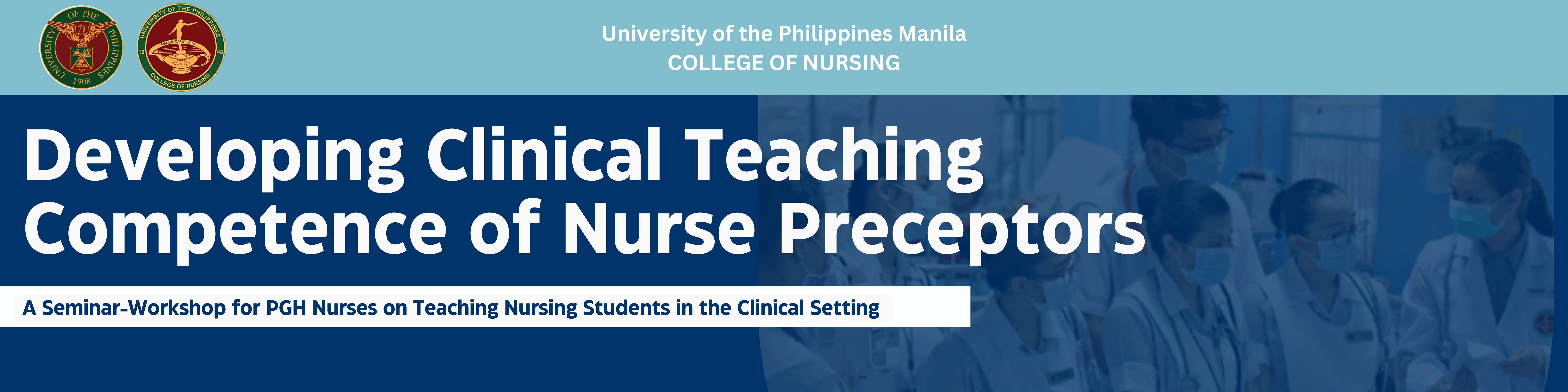
This is a three-day seminar-workshop with clinical practicum focusing on the valued role of a clinical teacher in student achievement of competencies. This activity deals with teaching and learning in the clinical context in the UPCN BSN Curriculum. It describes the roles and responsibilities of the clinical teacher, competencies of the students, and the most effective way to teach students in the clinical setting.
Course Description
This course aims to enhance public health nursing competencies in areas essential to health systems strengthening: health systems delivery, health financing, health regulation, health governance, health information systems, and the management of human resources for health. This will enable the nurse to take on the role of leader, manager, advocate, and care provider of various clientele in primary care facilities while utilizing a primary health care approach and in the implementation of universal health care. At the local health systems level, be it provincial or city-wide, this course will train public health nurses as primary care facility managers who are capable of managerial, technical, and financial integration.
Program Outcomes
At the end of the course, the learner is expected to:
Direct the provision of safe and quality health care and nursing service through Universal Health Care and Primary Care;
Manage the implementation and evaluation of individual and population-based health services based on assessed needs of the community with emphasis on disease prevention and health promotion;
Initiate collaboration and partnership with other health care providers, stakeholders, facilities and agencies towards creating an efficient and effective delivery of public health services within a health care provider network;
Develop relevant health policies that address priority health problems based on assessed needs of the community;
Manage public health programs and services including social health insurance programs to ensure equitable and universal access to health care;
Ensure continuous quality improvement of health services and facilities to enhance the integration of local health systems;
Supervise health human resource ensuring adequate skill mix and competencies of health workers, especially primary care workers; and
Apply principles and best practices in health informatics to ensure efficient data management and information systems.
This online course aims to develop the capacity of public health workers involved in caring for older persons in primary health care settings to ensure an understanding of the health and social needs of older persons and provide care for them in primary health care settings.
Target Learners
The course has been specifically designed for public health workers, including doctors, nurses, midwives, and other allied health professionals involved in caring for older persons.
Course Objectives
At the end of the course, the learner is expected to:
Welcome to an e-Learning Course on Mental Health Gap Action Program - Intervention Guide (mhGAP-IG) for Nurse Educators!
Target Learners:
This online course has been designed for faculty members who teach mental health, neurological and substance use (MNS) conditions in the undergraduate program in Nursing schools.
Demonstrate the application of the general principles of clinical care, particularly:
the use of effective communication skills; and
promotion of respect and dignity
Describe the assessment principles and concepts of mental health conditions
Discuss management strategies/ interventions for mental health conditions
Explain follow-up management of clients with mental health conditions
Demonstrate the application of the clinical protocol guidelines for the management of mental health conditions
Identify teaching methods and resources for the nurse educator’s delivery of the topic to undergraduate nursing students
The EMBEDDING PRIVACY AND CONFIDENTIALITY PROGRAM (EPiC-NP) is specifically designed for nurses to improve their health privacy practices, especially when processing personal data necessary for healthcare delivery. It will provide nurses with a useful aspect of navigating the multifaceted landscape of privacy and its dimensions that they can apply in their professions.
It is a 12-week nurse-led intervention program that aims to enhance nurses' health privacy practices by focusing on their knowledge, skills, and attitudes (KSA). The course is divided into two parts: 1.) Intensive EPiC-NP Training Course, 2.) EPiC-NP Nurse Application.
The goal of this program is to develop and prepare midwives with the necessary competency and skills to become primary health care workers, enabling the development of local health systems and the provision of primary care according to the health needs and demands of the community.
This training course is a component of the project, InControl: A nurse-led infection control care bundle for pediatric hematology-oncology. This training is focused on one of the components of this care bundle, particularly on family and caregiver health education. Cutting across a number of Sustainable Development Goals, along with the Global Initiative for Childhood Cancer, this course is designed for Master’s prepared nurses and health professionals in childhood cancer care to gain the knowledge and confidence to implement health education sessions.
This project is being implemented with support from the My Child Matters Grant of the Sanofi Espoir Foundation.
This public health nursing course includes six competence areas essential to the health systems approach: health systems delivery, health financing, health regulation, health governance, health information systems, and the management of human resources for health. This course will enable the nurse to take on the role of leader, manager, advocate, and care provider of various clientele in primary care facilities as part of the universal health care implementation.
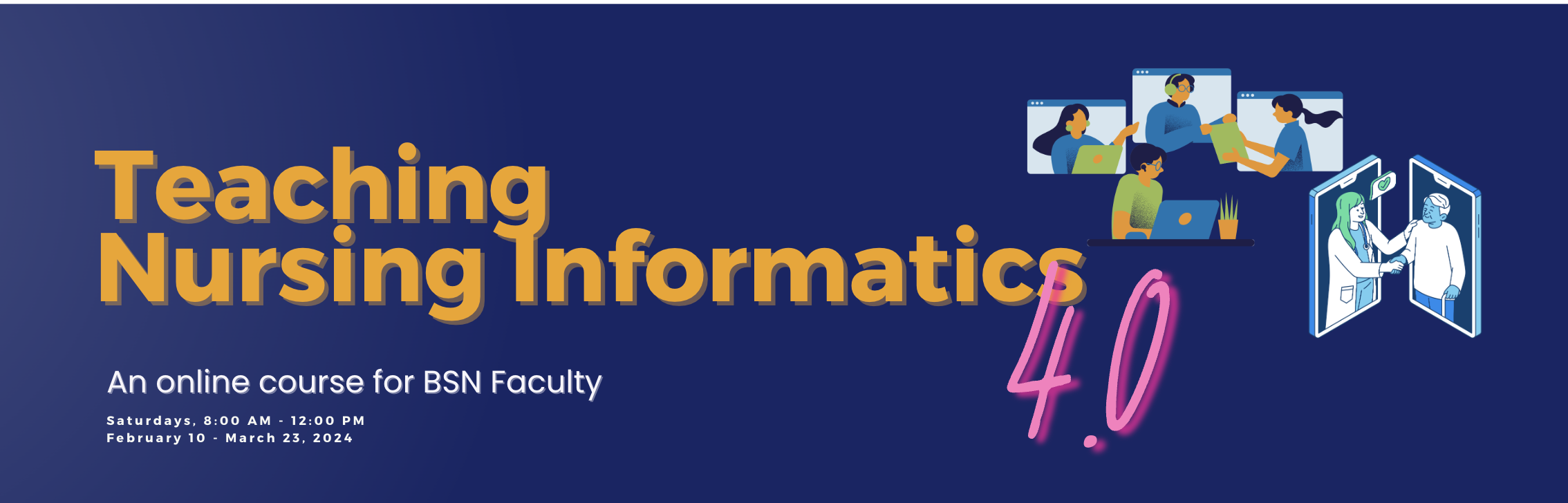
This certificate program in nursing informatics is specifically structured and geared to help Master's prepared nurses gain the knowledge and confidence to teach this course appropriately in the undergraduate program. This is an 8- week course using synchronous and asynchronous module-guided sessions and project-based activities through the UP College of Nursing Virtual Learning Environment (UPCN VLE).
At the end of this course, the student will:
Online Training Workshop on Principles of Good Clinical Practice & Health Research Ethics is a joint offering of the University of the Philippines Manila - National Health Institutes and the University of the Philippines College of Nursing. The participants of this training workshop are from different disciplines across the country who need certification as stipulated in the 2017 National Ethical Guidelines for Health Research.
This 3-day training workshop aims to 1) apply principles of good clinical practice and research ethics in the evaluation and approval of health research protocols; 2) demonstrate an operational understanding of various types of health research and their related ethical issues, and 3) address ethical issues in protocol development.